


In the modern e-commerce landscape, customer acquisition has become a steep and expensive uphill battle. Brands routinely pour massive budgets into top-of-funnel display ads and speculative demographic targeting, only to watch their return on ad spend (ROAS) steadily decline. Amid this aggressive race for consumer attention, merchants consistently overlook an organic revenue engine hiding directly on their storefronts: the gifting economy, a market sector that historically commands roughly 40% of all retail commerce.
The root of this missed opportunity lies in how traditional online retail handles consumer intent. For decades, the standard wishlist has functioned as an isolated, passive storage folder—a place where an individual shopper saves products they might think about buying later.
Standard wishlist plugins fail to engage the person actually holding the credit card: the gift buyer. They archive desire but do nothing to build a bridge to the purchasing network. Perceived as a simple storage app, the wishlist is frequently left on the table.
To break this pattern, merchants must look at the technology through an entirely new lens: a re-engineered wishlist is not a passive storage utility; it is a high-yield, zero-waste commerce channel.

Unlocking the Anonymous Gift Buyer
Traditional ad targeting operates on a single-user model. If a consumer browses a storefront for a milestone gift, ad networks tag that specific browser as the target buyer, resulting in weeks of repetitive post-purchase retargeting for a product they will never buy for themselves.
Concurrently, ad algorithms remain completely blind to the explicit tastes, sizes, and preferences of the true recipient. This structural blind spot triggers broad seasonal ad spending that inflates marketing costs and fails to reach the proper consumer circles.
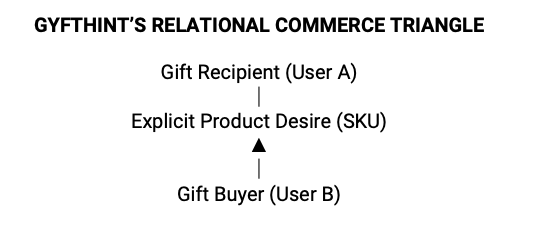
GyftHint’s Gifting Retail Interface Platform (GRIP™) changes this dynamic by replacing speculative guesses with a native, zero-party relationship graph. Instead of isolating intent on a single dashboard, the architecture maps a multi-node path connecting the recipient, their exact desired products, and the specific circle of buyers authorized to view that profile.
When a customer adds a product from your Shopify storefront to their registry, they open a direct, high-trust acquisition pipeline straight to their family, friends, and close connections. The gift buyer is no longer an anonymous visitor guessing at preferences; they are brought directly into your commerce ecosystem with an exact blueprint for a successful purchase.
Converting Turning Network Contacts into New Customers
By treating the wishlist as an active connection network, merchants gain access to an audience with an immediate, baseline trust in the brand. Behavioral research reveals that up to 92% of global consumers trust recommendations from friends and family far above traditional advertising formats, and this organic word-of-mouth directly shapes up to half of all purchasing decisions.
When a recipient pins a merchant’s product, they act as a highly trusted ultra micro-influencer to the exact sub-network of people guaranteed to spend capital on them.

This relationship dynamic rewrites the economics of customer acquisition. Instead of paying expensive marketing costs to display networks or macro-influencers, merchants can leverage GyftHint’s native network loops to welcome pre-qualified buyers to their storefront.
Furthermore, when independent Shopify brands utilize this relational framework alongside pre-authenticated checkout ecosystems like Shop Pay, the purchasing journey is streamlined into just a few clicks. This frictionless experience can increase transaction conversion velocity by up to 50%, transforming an introductory gifting interaction into a seamless, high-converting entrance point for a new customer.
Direct-to-Device Timing and the Automation of Intent
An active commerce channel requires more than static product visibility; it demands a structured, time-sensitive communication loop that drives action exactly when it matters. GyftHint achieves this by layering an automated 30/10/0-day countdown notification engine directly over the mapped relationship graph, moving communication away from crowded email boxes and onto direct-to-device channels that command 98% average open rates.

Building an Unshakeable Margin Moat
The long-term value of converting gift buyers into core customers lies within its protective impact on your profit margins. Traditional, unguided gifting models impose a heavy operational toll on merchants, resulting in an industry-average 20% product return rate. Processing these blind returns introduces a severe backend drain, with reverse transit shipping, warehouse reclamation labor, and repackaging eating up an average of $27.00 per returned item.

By shifting your audience to an active, relationship-driven commerce model, the product return rate drops to less than 1%. Because buyers are armed with the exact sizes, styles, and color preferences verified by the recipient, the transaction maps cleanly from the start.
Preventing these costly logistical mistakes preserves thousands in capital every month for a growing brand, turning your digital storefront from a speculative marketplace into a high-margin business engine.
The active wishlist model shifts the entire e-commerce ecosystem away from broad web tracking and toward a sustainable framework rooted in explicit consumer value, real human connection, and high-velocity relationship commerce.
Frequently Asked Questions (FAQs)
Traditional checkouts treat gift givers as one-time anonymous buyers. GyftHint maps these buyers directly to a recipient’s zero-party relationship graph. This brings them into your ecosystem with clear context, establishing a high-trust pipeline for future acquisition.
GyftHint utilizes natural word-of-mouth verification. Because 92% of consumers trust recommendations from friends and family over traditional ads, a recipient pinning your product acts as a high-validation endorsement that drives frictionless buyer conversions.
Instead of using crowded email inboxes, GyftHint uses direct-to-device alerts commanding a 98% open rate. Pushing notifications 30 and 10 days before an event keeps your brand top-of-mind, driving immediate actions exactly when buying intent peaks.
Instead of blasting broad, margin-diluting discount codes, merchants can inject precision incentives directly into the buyer circle of a user who has pinned their specific SKU. This hyper-focused approach drives rapid conversion velocity with zero ad waste.
Speculative gifting triggers a 20% return rate, costing merchants an average of $27.00 per item in reverse logistics. GyftHint equips buyers with sizes and styles verified directly by the recipient, dropping returns below 1% to maximize profitability.