


Why Traditional Shopify Wishlists Are
Leaving Revenue on the Table

For years, the e-commerce wishlist has served a simple, predictable purpose: allowing online shoppers to save products for future consideration. It exists across millions of Shopify storefronts as a standard utility—a digital closet where consumers store items they might consider purchasing at some point down the line.
While this setup offers basic organizational convenience for an individual shopper, it creates a hidden operational drain for the modern retailer. Traditional wishlists are completely disconnected from real-world buying timelines, collaborative networks, and relationship dynamics. They operate as passive data graveyards where valuable consumer intent is captured, isolated, and left to expire.
In today’s hyper-competitive e-commerce landscape, merchants can no longer afford to host tools that merely archive customer intent. Relying on passive registry modules acts as a silent tax on a brand’s bottom-line gross margins. Because standard wishlist plugins are entirely blind to relationship-based gifting intent—which commands roughly 40% of total retail commerce—merchants are forced to depend on speculative, broad-based marketing.
This systemic gap leads to an inefficient, industry-standard 1.5% hit rate on seasonal advertising campaigns, as brands waste millions trying to guess who is buying what for whom. It is time to shift merchant perception: the wishlist must evolve from a static storage feature into an active, revenue-generating commerce channel.
THE TRADITIONAL WISHLIST LEAKAGE
Passive “Save for Later” Button = Isolated Single-User Intent = Cart Abandonment= < 1.5% Conversion Rate
The Operational Burden of Speculative Buying
The financial inefficiencies of standard wishlist models extend far beyond poor ad conversion rates. Speculative gift buying triggers a continuous cash drain on the backend of the retail supply chain. Enterprise retail data establishes that the average cost to process a single physical e-commerce return has reached $27.00. This includes the compounding overhead of reverse transit shipping, warehouse reclamation labor, inventory grading, and repackaging.
Because unguided holiday and milestone gifts carry an industry-average 20% return rate, blind gifting mechanics directly erode merchant profitability. On a standardized merchant baseline processing a modest cohort of 1,000 gift transactions per month, traditional wishlist limitations allow approximately 200 items to flow backward through the supply chain, leaking $5,400 monthly in pure reverse-logistics friction.
Speculative Vs. GyftHint Gift Buying
1,000 Blind Gift Orders ➔ 20% Return Leakage (200 Units) ➔ $27.00 Return Fee ➔ $5,400 Cash Drain
VS.
1,000 Verified Orders ➔ <1% Return Leakage (<10 Units) ➔ Accurate Intent Matching ➔ $5,130 Cash Retained
By transitioning the purchase journey to a verified, collaborative pipeline, the product return rate drops to less than 1%. By replacing speculative assumptions with verified accuracy, a merchant instantly recaptures $5,130 in reverse-logistics processing costs per 1,000 transactions. Concurrently, by onboarding organic, high-affinity network buyers via automated milestone loops rather than purchasing speculative programmatic ad placements, the merchant retains an additional $25,000 in marketing capital. Within a modern e-commerce architecture, preventing an invalid transaction is structurally more profitable than processing a physical exchange.
Activating GyftHint’s Relational Gifting Graph
A traditional wishlist operates in complete isolation because it only tracks a single user’s browsing profile. GyftHint changes this dynamic by introducing the Gifting Retail Interface Platform (GRIP™), an ecosystem infrastructure that replaces probabilistic assumptions with deterministic relationship mapping. The architecture maps data along a clear, multi-node path that connects the recipient, their explicit product desires, and the specific circle of buyers authorized to view that profile.
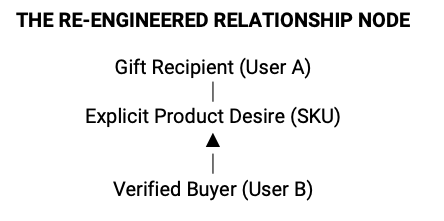
By building this closed-loop permission network directly into the core of digital commerce, the wishlist ceases to be an unread, static folder. It becomes a year-round transactional pipeline. Consumers explicitly organize their inner circles, establishing a network for birthdays, holidays, and major life milestones.
This structural realignment satisfies two core psychological needs simultaneously. It gives recipients a voice regarding what they truly want while fully preserving the emotional payoff of surprise for the buyer. Because the buyer circle coordinates behind the scenes, duplicate purchases are eliminated without ruining the blind-box secrecy for the recipient. The wishlist transforms from a lonely, isolated tool into a living connection network.
The Temporal Pipeline: Timing Meets Intent
A passive wishlist completely lacks urgency; it has no concept of time, shipping deadlines, or milestone execution constraints. GyftHint eliminates this deficit by layering an automated 30/10/0-day countdown notification engine directly over the relational graph. This operational framework acts as the “oil” of the graph, shifting wishlists from static web views into active purchasing sprints by systematically alerting the designated buyer circle at critical operational intervals.
THE RE-ENGINEERED TIMING PIPELINE
30 Days Out: Intent Activation ➔ 10 Days Out: Precision Promotion ➔ Day 0: Frictionless Execution
This countdown sequence structures the transaction into three highly actionable phases:
- 30 Days Out (Intent Activation Loop): The system triggers notifications to the verified buyer circle, gathering early demand and opening a comfortable window for group coordination, retail shipping, and logistics.
- 10 Days Out (Urgency & Conversion Layer): Follow-up reminders are sent directly to the device, dynamically injecting real-time, time-sensitive merchant promotions to trigger immediate checkout conversions and eliminate standard cart abandonment.
- Day 0 (The Event Execution Peak): Final notification sequences surface instant-delivery routing, digitized merchant gift cards, or local direct-to-consumer storefront pickups on the exact day of the milestone.
The Precision Promotional Catalyst
The ultimate breakthrough of the active wishlist model lies within its ability to deploy hyper-targeted relationship promotions. Instead of blasting generic, margin-diluting discount codes to broad public audiences, partner merchants can inject precision incentives straight into the buying circle of a user who has already explicitly pinned their product SKU. This creates a powerful commercial feedback loop where a promoted product can be measured in real time against non-promoted items within the same registry pool. This ability to isolate, track, and prove how merchant promotional dollars directly accelerate buyer decision-making represents the definitive analytics holy grail of modern ad-tech.
Furthermore, this framework turns every gift recipient into an ultra-micro influencer of their own immediate buying circle. Rather than paying soaring customer acquisition costs (CAC) to macro-influencers or untargeted display ad networks, brands can utilize these native networks to convert at an unprecedented rate with near-zero ad waste. Product discovery is completely decentralized, blowing traditional social media conversion metrics completely out of the water.
LEGACY VS. GYFTHINT’S ACTIVE PRIVACY MODEL
Legacy Tracking: Brittle Third-Party Cookies ➔ Device Fingerprinting ➔ Probabilistic Speculation
GyftHint Active Network: Zero-Party Volunteered Inputs ➔ First-Party Secure Enclosure ➔ Opt-In Direct Consent
As modern privacy initiatives continually dismantle traditional cross-site tracking and third-party web cookies, active data networks offer a sustainable, future-proof solution for e-commerce. Because users intentionally volunteer their personal preferences, item choices, and milestone dates, the data engine operates with absolute clarity and complete regulatory safety. It shifts the entire e-commerce ecosystem away from intrusive web surveillance and toward a model rooted in explicit user value, real connection, and precision commerce.
Frequently Asked Questions (FAQs)
Why do traditional wishlists leave merchant revenue on the table?Traditional plugins act as passive storage archives where single-user intent is isolated and forgotten. They are completely disconnected from relational buying timelines and the massive 40% gifting economy, forcing brands to rely on broad, low-yield ad campaigns.
How does speculative gift buying impact a store’s bottom line?Unguided gifting suffers from a 20% return rate. Processing these returns costs an average of $27.00 per item due to shipping and warehouse overhead, draining $5,400 monthly for a merchant processing 1,000 blind gift orders.
How does the Gifting Retail Interface Platform (GRIP™) fix this leakage?Instead of tracking an isolated profile, GRIP™ builds a live relationship graph connecting the recipient, their exact desired SKUs, and a verified buyer circle for friends and family. This drops return rates below 1%, instantly recapturing $5,130 in reverse-logistics overhead per 1,000 transactions.
What is the purpose of the 30/10/0-day countdown pipeline?Passive wishlists lack execution urgency. GyftHint sends direct notifications to activate the buyer network 30 days before a milestone and deploys optional targeted merchant promotions 10 days out to prevent cart abandonment.
How do precision relationship promotions protect merchant margins?Instead of blasting generic public coupons, merchants deploy optional specific price subsidies straight into the buying network of a user who pinned their SKU. This builds a trackable commercial feedback loop that accelerates purchase velocity with zero ad waste.